What TinySA support means
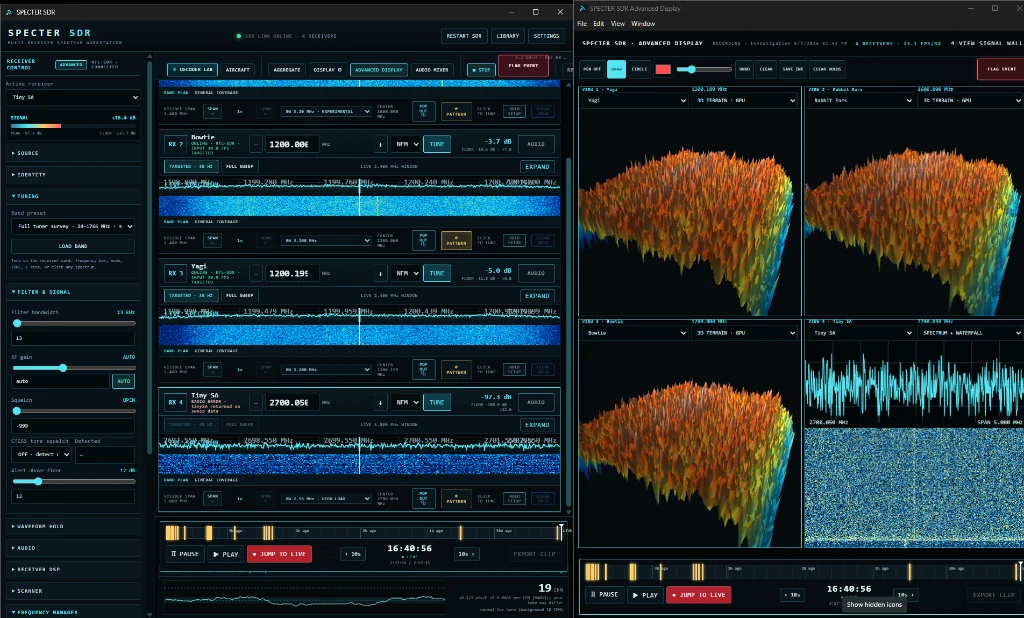
SPECTER supports TinySA-family instruments that identify through the TinySA USB serial shell. The analyzer appears beside connected radios as a named spectrum-only source. SPECTER asks the instrument for its actual sweep limits instead of assuming a model, so available spans follow the connected hardware. A TinySA Ultra+ can reach approximately 5.4 GHz, while earlier models report lower limits.
Connect and enable the analyzer
- Connect the TinySA to the Windows computer with a USB data cable and switch the instrument on.
- Open Settings, then System.
- Enable Spectrum analyzers (TinySA) and save settings.
- Use Check USB Connection if the analyzer does not appear.
- Select the TinySA from the active-source list and assign a clear name.
TinySA uses the Windows USB CDC serial path and normally needs no custom driver. A charge-only cable can power the instrument without creating a data connection, so try a known data cable before changing Windows drivers.
Analyzer controls
| Control | Purpose |
|---|---|
| Center frequency | Places the selected sweep around a specific part of the instrument's supported range. |
| Sweep span | Selects widths from focused local sweeps through the full device-reported range. |
| Sweep points | Choose 101, 145, 290, 450, or 900 points. Lower counts update faster; higher counts provide more frequency detail. |
| Resolution bandwidth | Use automatic RBW or select 3, 10, 30, 100, 300, or 600 kHz when the instrument supports it. |
| Attenuator | Use automatic attenuation or select 0, 10, 20, or 30 dB for strong-signal environments. |
| Low-noise amplifier | Enable the TinySA LNA when appropriate for weak signals and the connected model. |
Visualize, record, and review
TinySA sweeps are translated into the same timestamped spectrum-frame format used by SPECTER's visual pipeline. You can place the analyzer in the main workstation or Advanced Display, view spectrum and waterfall history, preserve its trace in a recording session, and review it against the shared timeline. The analyzer remains independently identified so its data is never mistaken for IQ from a radio receiver.
Analyzer-specific alerts
Enable Spectrum analyzer alerts only when you need them. A wide analyzer sweep can encounter many active signals, so SPECTER uses a separate threshold measured in dB above the analyzer's own sweep floor. Start conservatively, observe the local baseline, and use the analyzer's per-source alert override when the general threshold is too active.
Functions that require a radio
- Audio monitoring and demodulation modes
- IQ recording, replay, and constellation views
- Decoder Lab, ADS-B, and external protocol engines
- Coherent receiver pairing and relative-amplitude radio direction comparison
- Radio squelch scanning and CTCSS detection