STACKED LIVE WORKSPACES
Every receiver gets its own spectrum, band plan, waterfall, signal meter, tuning state, hold controls, and focus mode.
SCAN THE SPECTRUM. IDENTIFY THE SIGNAL. PRESERVE THE EVIDENCE.
Coordinate one to eight supported local or remote receivers from one Windows workstation. Partition live scans, decode wireless sensors and telemetry, compare directional activity, run up to six analysis views at once, and preserve synchronized RF evidence for review.
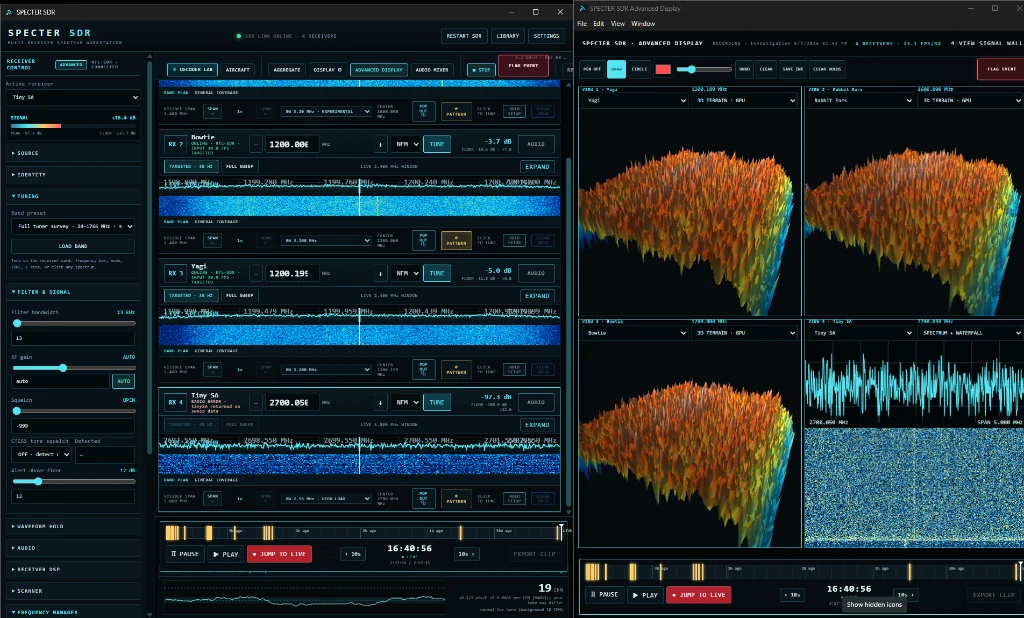
These are real SPECTER SDR application views, not concept renders. Open any image for the full-resolution interface.
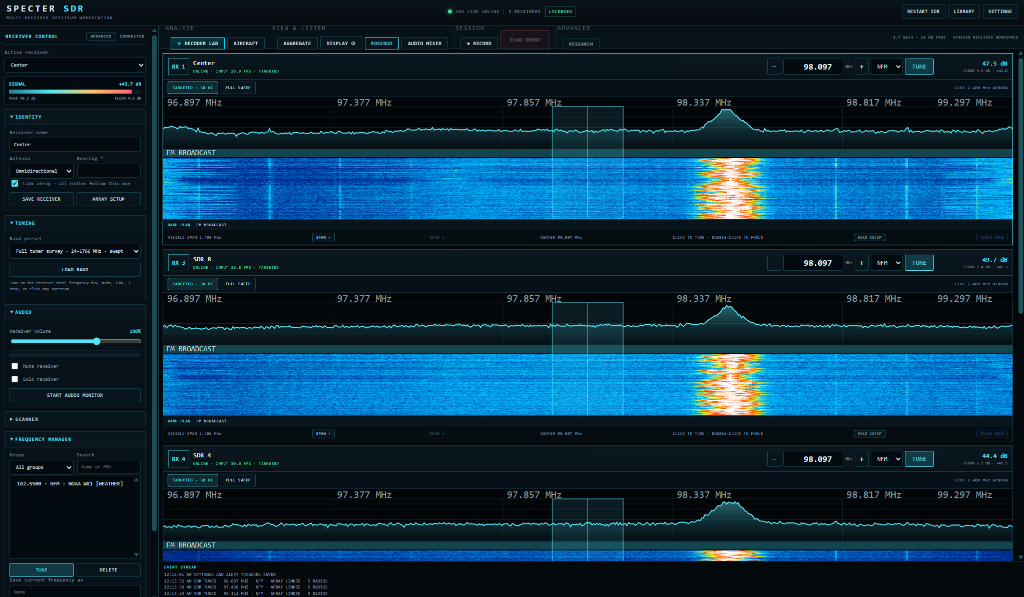
Multiple VFOs inside one sampled passband are useful, but they are not the same as coordinating independent receivers. SPECTER SDR gives each supported local or remote radio its own frequency, bandwidth, antenna role, demodulation, audio, scan assignment, visual history, and recording track, then brings the array together for correlation and review.
Real controls, real local processing, and a workflow built for long monitoring sessions rather than quick single-radio checks.
Every receiver gets its own spectrum, band plan, waterfall, signal meter, tuning state, hold controls, and focus mode.
NFM, WFM, AM, DSB, LSB, USB, CW, and RAW modes with bandwidth, filter, shift, gain, squelch, and calibration controls.
Compare simultaneous events across antennas, infer direction from amplitude relationships, and flag movement across the array.
Define frequency ranges and dB-over-floor thresholds per receiver, preserve peaks, and clear individual or array-wide holds.
Hear every active receiver through one mixer with channel volume, mute, solo, live meters, and a master output.
Build Notice, Alert, and Critical classes by threshold and band, then capture synchronized waveform evidence when they fire.
Split 24-1766 MHz across the connected array and stitch each receiver slice into one faster combined spectrum and waterfall.
Render spectrum interpolation and waterfall palettes through WebGL2, with automatic high-performance canvas fallback.
Mix supported receiver families around the job. SPECTER reads each radio's available tuning, gain, and sample-rate controls instead of forcing every device into an RTL-SDR profile.
Add a tinySA or tinySA Ultra as a spectrum-only source beside the radio array. SPECTER reads the instrument's own frequency limits, sweeps power against frequency, and routes the trace into its spectrum, waterfall, timeline, recording, and optional analyzer-alert tools.
Choose a frequency range or a saved channel group. SPECTER SDR partitions the work across the connected array, attributes every hit to the receiver that heard it, and leaves a dedicated ADS-B radio untouched.
Split contiguous ranges or saved channel groups across every available receiver.
Pause each radio independently while active transmissions remain above the configured floor.
Revisit priority channels, skip current activity, and persist nuisance-frequency lockouts.
Store time, frequency, strength, duration, detected CTCSS tone, and receiver identity.
Move frequency lists, raw signal recordings, remote radios, aircraft data, audio, and tuning commands through established radio formats and protocols.
Search and group named frequencies, tune on double-click, and import or export CSV lists.
Detect all 38 standard PL tones, filter NFM audio by tone, and stamp tones onto scanner hits.
Record gapless cu8 baseband, then replay cu8 or cf32 files at real-time pace with metadata restored.
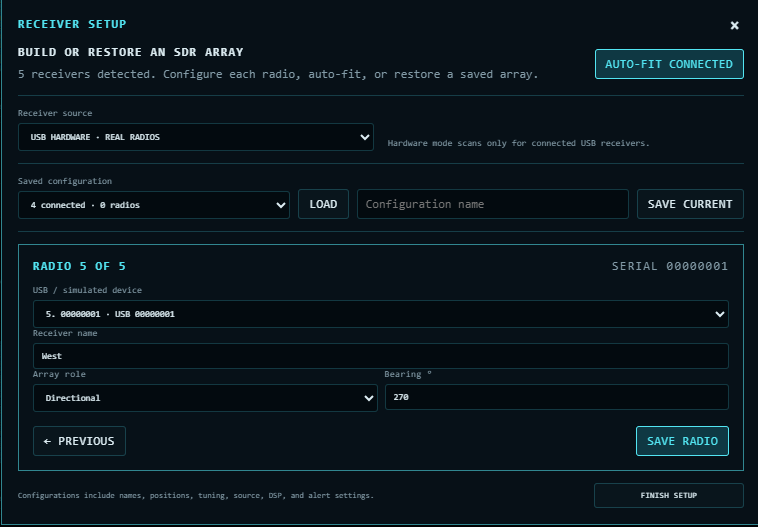
Add roof, field, or network receivers as full array elements with forwarded tuning and gain controls.
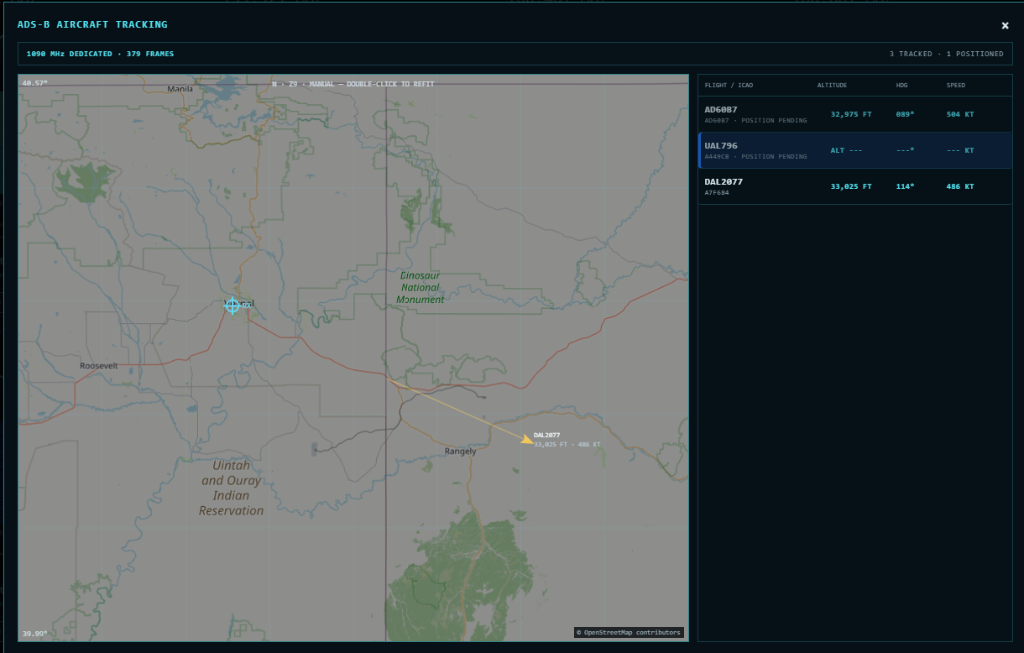
Feed decoded aircraft over BaseStation TCP and stream a receiver's MP3 audio to an Icecast mount.
Let hamlib-compatible software read and retune a chosen SPECTER receiver through a standard TCP endpoint.
Decoder Lab brings 14 guided profiles into one receiver-tagged feed. Five built-in decoders validate Mode-S and ADS-B, AX.25 and APRS, POCSAG, and NOAA SAME frames. Supported local engines add wireless sensors, radiosondes, AIS, ACARS, digital voice events, and NOAA APT weather-satellite products.
1090.000000 MHz · ALT 28,900 FT · 446 KT · HDG 071°
144.390000 MHz · POSITION / STATUS FRAME
162.550000 MHz · ORIGINATOR / EVENT / LOCATION
Use guided rtl_433 profiles to identify compatible weather stations, temperature and humidity sensors, tire-pressure monitors, utility devices, alarm sensors, remotes, and other short-range transmitters. Add auto_rx to follow radiosonde position, altitude, velocity, and atmospheric telemetry.
Identify compatible North American sensors, remotes, tire-pressure monitors, and short-range device telemetry.
Decode supported weather sensors, environmental probes, remotes, alarm devices, and utility transmitters.
Monitor compatible European short-range devices with selectable sub-band guidance and receiver-tagged results.
Target supported wideband sensor traffic using known device frequencies or a focused array survey.
Use auto_rx for supported RS41, DFM, M10, M20, and related weather-balloon telemetry around 400 to 406 MHz.
Keep device identity, measurements, checksums, frequency, receiver, and timestamp in the same Decoder Lab feed.
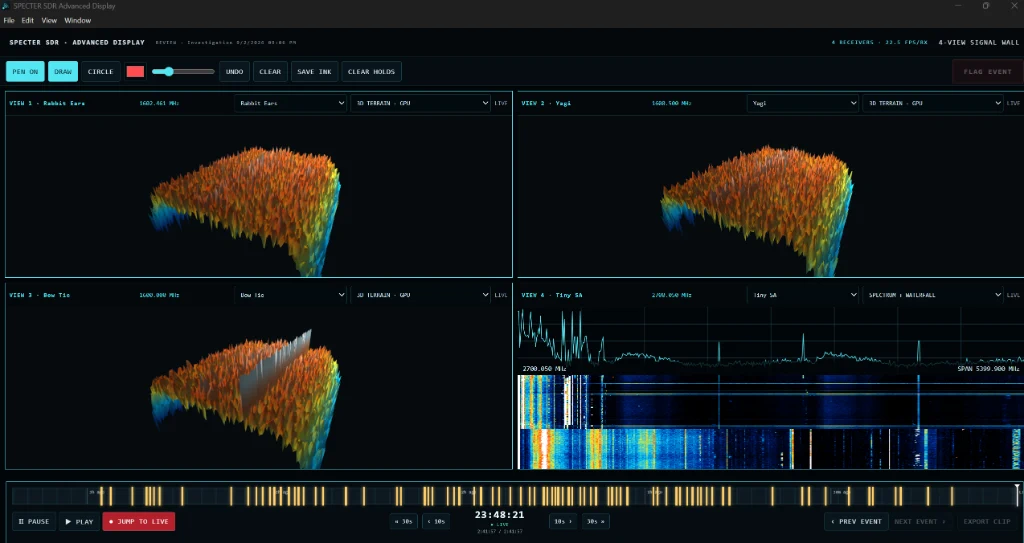
Build a one-to-six-tile Advanced Display from any connected receiver. Mix interactive 3D terrain, 3D spectrum, 3D waterfall history, conventional spectrum and waterfall, Persistence, or Spectrum Tunnel, then review every tile against one synchronized timeline.
Inspect exact frequency, bandwidth, level, and scrolling history with adaptive scaling and palette controls.
Accumulate signal density so steady carriers, brief emitters, weak excursions, and noise-floor variance remain visible.
Inspect peaks and neighboring energy as interactive signal geometry across the selected receiver's live span.
Turn recent spectral history into a time surface so drift, repetition, and changing bandwidth stand out.
Orbit accumulated signal structure with GPU acceleration and an automatic Canvas2D fallback.
Move to the leading edge of received history and look through measured terrain as it develops over time.
Score frequency bins against the receiver floor and expose intermittent activity through observed duty cycle.
Compare bearing-assigned receivers by relative amplitude, agreement, and resultant direction without claiming a location fix.
Plot live complex baseband to inspect carrier structure, noise clouds, clipping, and receiver quantization.
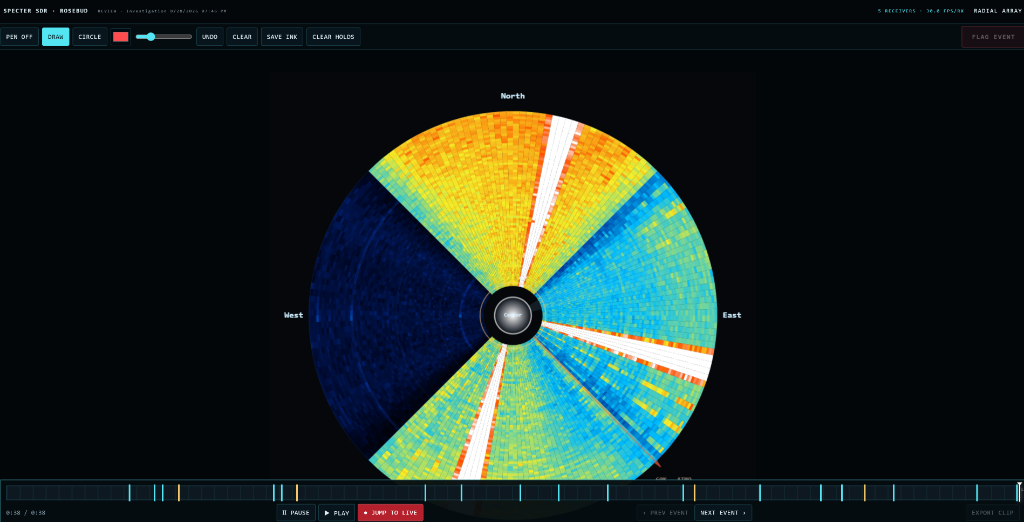
Assign names, physical slots, antenna types, and bearings, then move the array to a dedicated Rosebud window or second display. One receiver renders as a full 360-degree waterfall; larger arrays add comparative direction and confidence.
Record one workspace or Rosebud composite, lossless timestamped spectrum tracks, and per-receiver BWF audio without spawning one video encoder per dongle.
Drop event markers during the run. Alert classes automatically preserve frequency-labeled waveforms and synchronized array views.
Replay post-roll clips, navigate the timeline, export selected ranges, and open the exact saved Gallery event from the alert dialog.
Generate printable HTML and PDF alert reports with signal metadata, session context, and embedded spectrum and waterfall evidence.
Reserve one receiver for continuous ADS-B monitoring or let periodic mode borrow an assigned radio for a 10-second check every minute. Traffic extends the window to 15 seconds, then the receiver returns to its previous tuning automatically.
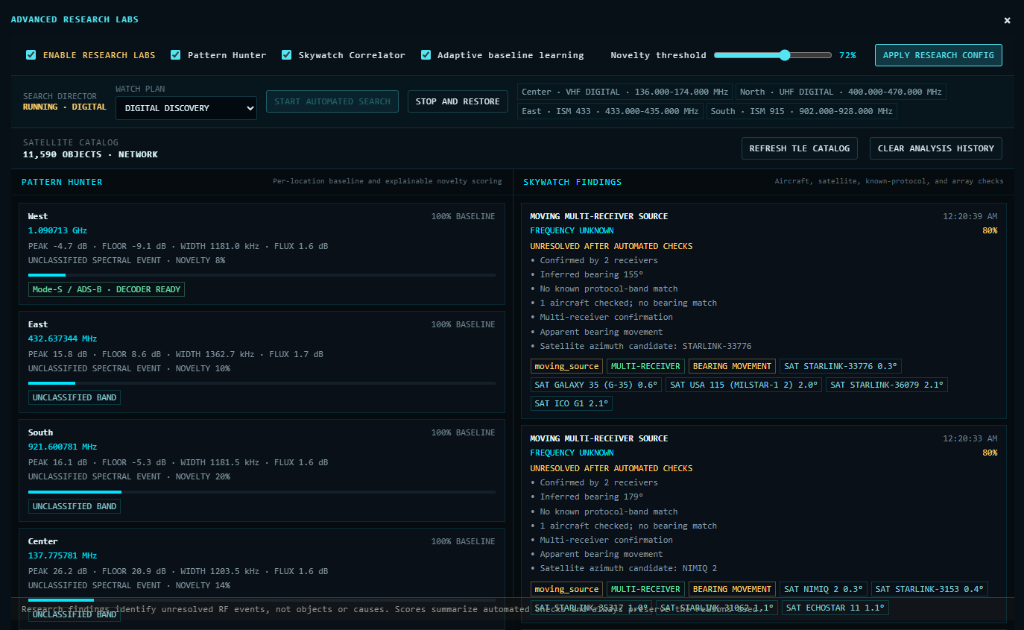
Research Labs stays out of the normal workflow until enabled. When active, it learns the local RF environment, distributes search bands across available radios, and checks qualified events against ordinary explanations.
Learns each receiver's normal spectrum and flags explainable novelty, chirps, Doppler-like drift, hopping behavior, periodic bursts, and wideband events.
Assigns aerospace, digital discovery, or wide survey ranges across idle receivers, alternates sweep direction, and restores saved tuning when stopped.
Compares findings with known protocol bands, live aircraft, visible satellites, array confirmation, bearing, and apparent movement before assigning a review status.
No cloud service is required for receiver control, decoding, pattern analysis, alerting, correlation, recording, reports, or the local evidence library. Optional map tiles and satellite catalog updates use OpenStreetMap and CelesTrak when those features are requested. SPECTER Imaging integration is optional and limited to local alert and trigger handoff.
No subscription and no required cloud service.