Reviewed September 24, 2026 against source v1.7.41. Features and fixes are labeled by version. Check release availability.
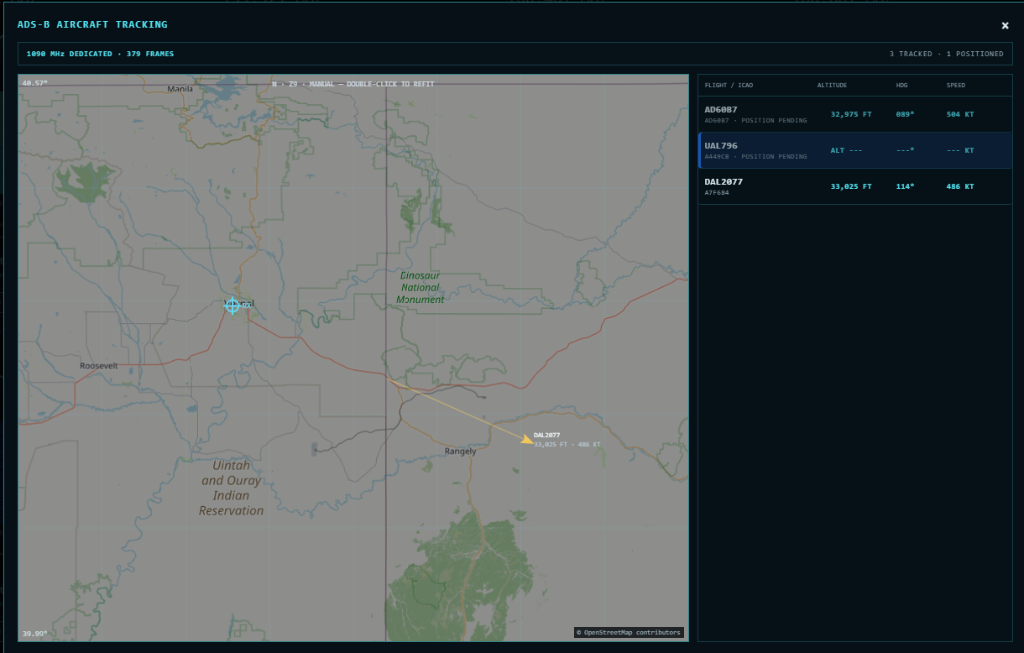
Self-contained ADS-B decoding
SPECTER SDR decodes 1090 MHz Mode-S and ADS-B directly, with no external decoder service. It tracks ICAO address, identity and callsign, altitude, airborne position, ground speed, heading, and vertical rate from validated frames.
Choose one ADS-B mode
| Mode | Behavior |
|---|---|
| Dedicated | Reserves one receiver at 1090 MHz continuously until ADS-B is disabled. |
| Periodic check | Borrows an assigned receiver for 10 seconds each minute. Traffic extends the window once to 15 seconds, then prior tuning is restored. |
The two modes are mutually exclusive. Search Director and normal source changes do not take control of a receiver reserved by dedicated ADS-B.
Set receiver location
Enter latitude and longitude in Settings, or press USE LAPTOP LOCATION to use Windows Location Services. The map reports the supplied accuracy when available. Manual coordinates remain the fallback.
Operate the aircraft map
- Scroll: zoom around the pointer.
- Drag: pan the map.
- Double-click: return to automatic fitting.
- Select an aircraft row: highlight that contact without hiding the others.
The header reports the zoom level and whether the view is AUTO-FIT or MANUAL. Once the operator pans or zooms, new contacts do not reset the view. Aircraft without a complete position remain visible as position pending.
Share decoded aircraft over SBS
Enable the BaseStation-format SBS server under Settings > Recording & Output to feed SPECTER aircraft data to readsb, Virtual Radar Server, or compatible feeder software. The default TCP port is 30003. See Network Output and External Control.
New-contact alerts
When enabled, a new aircraft card includes a map thumbnail, flight or ICAO identifier, altitude, heading, and speed.
Aircraft emergency alerts
| Squawk | Meaning |
|---|---|
| 7500 | Unlawful interference |
| 7600 | Radio or communications failure |
| 7700 | General emergency |
Emergency monitoring also reports lifeguard or medical, minimum-fuel, and downed-aircraft states. Alerts fire when an already-tracked aircraft changes into an emergency state, not only when a new contact appears. Emergency alerts remain visible until acknowledged and are logged to the event stream.
Audible new-aircraft notification (v1.7.40+)
Enable Settings > Alerts > Audible Alerts > New aircraft contact for a rising two-note chirp when the ADS-B new-contact notification is raised. The sound starts off by default and previews when checked. Also enable the relevant new-contact notification in the Aircraft settings; the sound switch alone does not start reception.
An ADS-B receiver is not a tinySA analyzer. Periodic ADS-B temporarily retunes its assigned radio, so use a different receiver for a continuous channel activity watch.