Reviewed September 24, 2026 against source v1.7.41. Features and fixes are labeled by version. Check release availability.
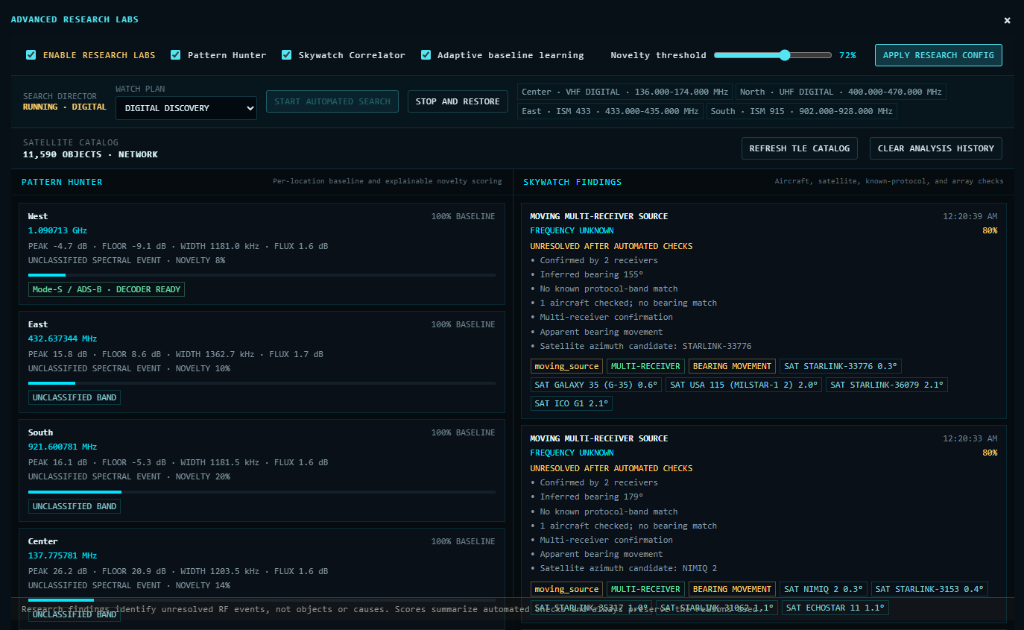
Known traffic and unresolved patterns stay separate
Decoder Lab handles known protocols and live packet output. Research Labs adds adaptive pattern discovery, distributed searching, and contextual checks without presenting a frequency match as a decode.
Research Labs
Press RESEARCH and enable the master switch. Research controls persist between panel refreshes.
Pattern Hunter
Learns a per-receiver baseline and flags departures such as chirps, Doppler-like drift, hopping, periodic bursts, wideband events, and otherwise unclassified novelty. The novelty threshold ranges from 30 to 99 percent.
Search Director
Distributes Aerospace, Digital Discovery, or Wide RF Survey plans across available non-ADS-B receivers, then restores their previous tuning when stopped.
Skywatch Correlator
Checks qualified findings against known allocations, tracked aircraft, cached CelesTrak orbital elements, multi-receiver confirmation, inferred bearing, and apparent movement. REFRESH TLE CATALOG updates the satellite catalogue.
A research score prioritizes evidence for review. It is not a probability and does not identify a cause.
Evidence and lawful use
Qualified findings are stored locally with their reasons, spectral signature, and contextual checks. SPECTER SDR is receive-only. Monitoring laws vary by country and band, and decoded private traffic must not be redistributed.
Do not confuse activity with identification
The v1.7.40 channel watch identifies an RF power change relative to learned background. Research scores, channel activity, validated packets, and radiation excursions are different observations. Preserve their timestamps and evidence rather than treating any one as proof of a cause. Search Director retuning also changes the channel a watch is evaluating.