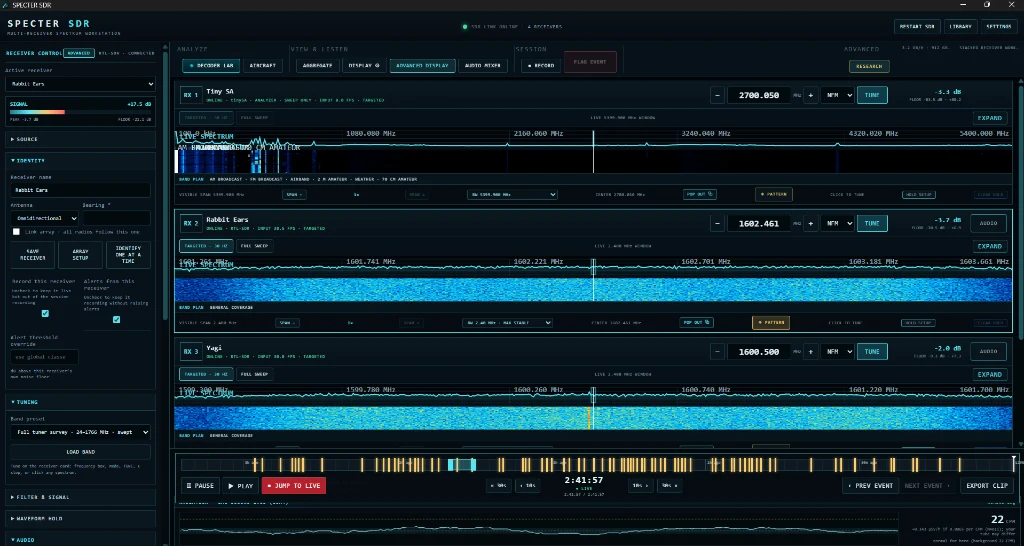
Independent receivers are different from multiple VFOs
A multi-VFO application can demodulate several channels inside one radio's sampled passband. A multi-receiver workstation can place independent radios on separate bands, assign different antennas and modes, hold on several transmissions at once, or divide a large search across the array.
What the array changes
Divide the work
Partition ranges or saved channel groups across available radios instead of making one tuner visit every frequency in sequence.
Keep every active channel
Each receiver can pause independently on activity while the rest of the array continues scanning.
Compare antennas
Use named roles, bearings, and amplitude relationships to prioritize a direction for investigation without claiming precision geolocation.
Preserve the whole event
Record receiver audio, spectrum history, markers, alerts, and visual context against one shared session timeline.
Supported sources
Use validated RTL2832U models including RTL-SDR Blog V3 and V4 and NESDR, bladeRF 1.x or 2.0 micro, and remote rtl_tcp sources. LimeSDR integration is included but remains under current Windows hardware validation. Hardware capabilities vary, so SPECTER reads available controls from each receiver and uses conservative live defaults.
One workflow from signal to evidence
Frequency Manager organizes channels. The array scanner distributes work. Decoder Lab handles known protocols. Advanced Display provides flat spectrum, 3D history, terrain, Rosebud, and aggregate views. Recording and Investigation Review keep the evidence synchronized. Each part uses the same receiver identities and timeline instead of sending the operator through disconnected tools.